

David Claerbout
David Claerbout / At the window
In June 2025, we will be welcoming At the window: an exceptional solo exhibition by the internationally celebrated artist David Claerbout (born 1969). His latest creation The Woodcarver and the Forest will premiere at Gaasbeek Castle. A work of art – not just to look at, but to live with.
The Woodcarver and the Forest presents itself as an intimate portrait of a reclusive young man and the attentive depiction of his only, seemingly banal occupation – woodcarving. Crafts, such as woodworking, have become the symbol for a generation looking for a way to relieve screen fatigue and forge a connection with the outside world and, above all, with nature. Simply watching a woodcarver transform a log into a spoon has an almost meditative effect. The repetitive, slow movements and gentle sounds of cutting and scraping form part of the phenomenon of ASMR (Autonomous Sensory Meridian Response), in which auditory or visual stimuli can generate a deep calm.
The Woodcarver and the Forest is a processual film that masquerades as an ever-repeating short film. Only when you spend enough time with the work does the film reveal its Janus-like character. Its natural beauty, with its lush forest views, hides what’s really going on. The heartache of watching the forest vanish, its trees felled one by one, is a powerful reminder of the passage of time. Before we know it, there may be nothing left. The message that Claerbout seems to be conveying is that overconsumption and precorporation are everywhere, even in the mindful consumer.
In addition to this new film, an ensemble of works by David Claerbout will be integrated into the historic rooms of the castle. The works themselves offer a new look at the collection and architecture of Gaasbeek Castle as a palimpsest or hub of time. But also at the crafts deeply intertwined with it, because coincidence or not: the castle is surrounded by a vast forest and contains ‘acres’ of woodwork in a nineteenth-century neo-Renaissance style.
This exhibition invites you to slow down and reflect.
Practical info
» From 27 June to 16 November 2025
» The exhibition At the window is part of the museum itinerary in Gaasbeek Castle
Gaasbeek Castle is a protected monument. We attach great importance to full accessibility and make an effort to make the castle as accessible as possible to the widest possible audience. Still, given the historic nature of the building, there are some limitations.
» The Woodcarver and the Forest is on display in the Emperor Charles Hall and can only be reached by stairs. The other artworks can be seen in the castle rooms on the ground floor, first floor and mezzanine floors. The ground floor is accessible, the first floor by using an elevator. The castle staff will be happy to help you. Five of the nine works are wheelchair accessible.
» To do full justice to certain video works, some rooms are darkened.
» Some videos are accompanied by audio. Although David Claerbout's works have a soothing character, this can be stimulating for some visitors.
» Take a look at the accessibility page for more information.

David Claerbout, The Woodcarver and the Forest, 2025, filmstill

David Claerbout, The Woodcarver and the Forest, 2025, filmstill

David Claerbout, The Woodcarver and the Forest, 2025, filmstill

David Claerbout, The Woodcarver and the Forest, 2025, filmstill

Publication / Birdsong
Birdsong brings together three video works by David Claerbout – The Woodcarver and the Forest, Birdcage and Backwards Growing Tree – each a meditation on time, perception and the poetics of the natural world. In an era dominated by speed and distraction, Claerbout reclaims the longue durée, offering a contemplative, detoxed form of filmmaking.
Accompanied by a poem by Stefan Hertmans, this volume explores the myths of digitisation, the rhythms of nature, growth and degrowth.
With countless film stills from a previously unreleased video, this publication offers a unique insight into the artist’s working process.This book is the highly anticipated sequal to The Silence of the Lens (Hannibal Books).
Both will be available in the Museumshop of the castle.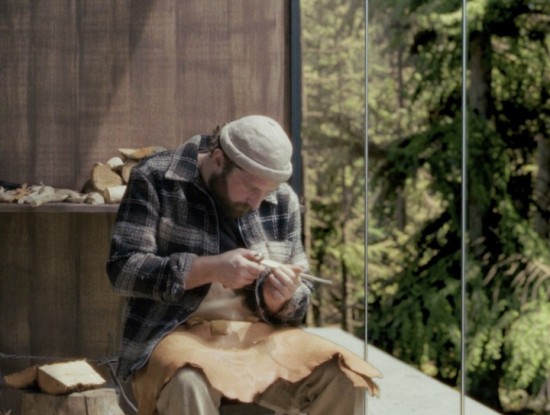
Five hours, fifty days, fifty years
18.10 » 22.02.2026
Konschthal Esch (Luxembourg) is hosting an exhibition featuring selected works by David Claerbout. The Woodcarver and the Forest is also on display here.


David Claerbout © Taipei Fine Arts Museum 2023
Bio David Claerbout
He trained as a painter, but became increasingly interested in researching photography and film. In his works, past, present and future merge into one. Claerbout does not encourage you to look, but to doubt: about time, about perception, about memory, about the image and the cinematic experience itself.
Using pixel constellations, image sequences, light, duration, ambient sound, installation environment, and the technologies used to convey these, his strikingly sensual compositions elicit new modes of perceptual absorption, expectations, comprehension and memory.
Since the first videos in the mid-1990s, his work rapidly gained complexity, and with the introduction of digital media in early 2000 it evolved into a practically completely synthetic image practice, which put him at the forefront of new media art. In relation to that "synthetic image", David Claerbout coined in 2018 the term dark optics, defining the changes within our image culture and the future of lens-based media. His thesis is that with the switch from analogue to digital lens-based media has increasingly become a product of AI, big data, etc. putting increasing pressure on the trust system promoted by the photographic image. David Claerbout is particularly interested in the effects of digital images on our "metabolism": i.e. how our physical and sensory reflexes change in response to stimuli in an increasingly digital environment.
He has been the subject of numerous solo exhibitions internationally, including: Taipei Fine Arts Museum (2023); Milwaukee Art Museum (2022); Kunstmuseum Basel (2020); Galerie Rudolfinum, Prague (2020); Kunst Museum Winterthur (2020); Kunsthaus Bregenz (2018); Schaulager, Basel; MNAC, Barcelona (2017); Städel Museum, Frankfurt; KINDL, Berlin (2016), Marabouparken Konsthall, Sundbybert (2015); Nederlands Fotomuseum, Rotterdam (2014); Secession, Vienna; Tel Aviv Museum, Tel Aviv; Parasol unit, London (2012); SFMOMA, San Francisco; WIELS, Brussels (2011); De Pont museum of contemporary art, Tilburg (2009 and 2016); Pompidou Center, Paris (2007); Kunstmuseum, St. Gallen, Switzerland (2008); and Van Abbemuseum, Eindhoven (2005).
His work is represented in major public collections worldwide.